 |
USRP Hardware Driver and Device Manual
Version: 4.11.0.0-0-g0d7ed3b1
UHD and USRP Manual
|


|
|
USRP Hardware Driver and Device Manual
Version: 4.11.0.0-0-g0d7ed3b1
UHD and USRP Manual
|
|
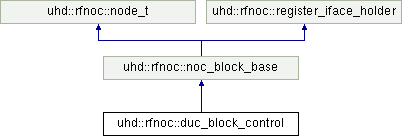
#include <uhd/rfnoc/duc_block_control.hpp>
DUC Block Control Class
The DUC is a multi-channel digital upconverter with a built-in DDS frequency shifter. It is commonly placed directly before a radio block to increase the sampling rate and shift a signal to the desired transmit frequency.
The block processes signed complex 16-bit samples (sc16). Each channel has an independent frequency shift and interpolation setting. The number of channels and the maximum supported interpolation are configured in the FPGA at synthesis time. The block controller reads these maximum capabilities, stored in capability registers, during initialization.
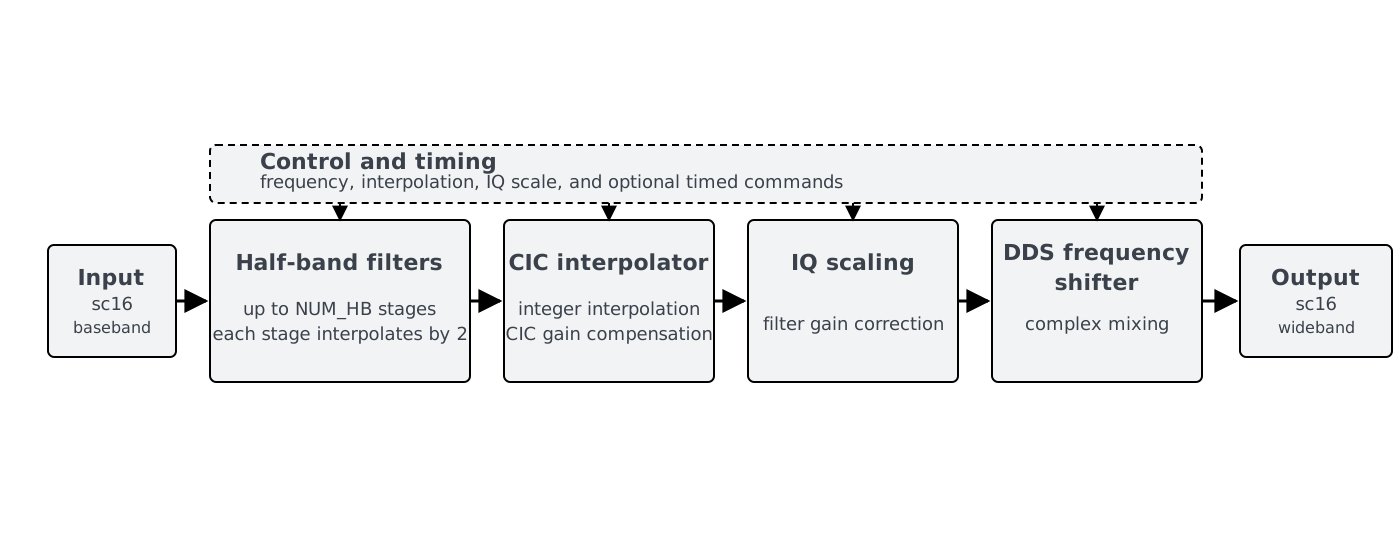
The total interpolation is the product of the CIC interpolation and the half-band interpolation stages. With NUM_HB half-band stages and a CIC limit of CIC_MAX_INTERP, the maximum supported interpolation is \(\mathrm{CIC\_MAX\_INTERP} \times 2^{\mathrm{NUM\_HB}}\).
The DUC FPGA block is configured through the following parameters:
NUM_PORTS: Number of independent DUC channels.NUM_HB: Number of half-band filter stages in each channel.CIC_MAX_INTERP: Maximum interpolation through CIC filter stage in each channel.NIPC: Number of samples processed per clock cycle. NIPC == 1 selects the legacy single-sample implementation. Values greater than one select the multisample implementation, which processes samples in parallel for wideband images.The in-tree DUC YAML descriptor derives NIPC from the configured RF bandwidth. Each parallel processing chain is sized for approximately 200 MHz of RF bandwidth, with the resulting value rounded up to a power of two. Customized FPGA images may choose a different value based on their clock rates and resource budget.
This block exposes two user-configurable configuration parameters per channel:
freq: Frequency shift in Hz. The set_freq() convenience method should be preferred over setting the property directly because it also handles a command time.interp: Integer interpolation value.The interpolation value can be changed at runtime, but a change is applied only between bursts. Once an interpolation value has been applied, it remains in effect for the entire burst.
The legacy single-sample DUC and the multisample (wideband) DUC react differently to timed and untimed frequency-shift commands:
NIPC IQ samples.In the multisample implementation, timed frequency shifts have word-level rather than sample-level granularity. One word is one data transfer containing NIPC samples (see NIPC). Therefore, if the requested timestamp falls within a word, the new frequency shift will be applied to samples earlier in that same word. For example, if the timestamp corresponds to the third sample in a word of eight samples, the new frequency shift will be applied to all eight samples in that word, including the first two samples preceding the requested timestamp, and to all subsequent samples until the next frequency change. The exact sample-level transition is not guaranteed.
The DUC has two register-map generations:
The block controller reads the FPGA compatibility number from REG_COMPAT_NUM and selects the corresponding register map. An unsupported major version is rejected. REG_ADDRS_V0 and REG_ADDRS_V1 contain the version-specific addresses used by the controller.
Classes | |
| struct | reg_addrs_t |
| Version-specific register addresses. More... | |
Public Member Functions | |
| virtual double | set_freq (const double freq, const size_t chan, const std::optional< uhd::time_spec_t > time={})=0 |
| double | set_freq (const double freq, const size_t chan, const uhd::time_spec_t time) |
| virtual double | set_freq (const double freq, const size_t chan, const boost::optional< uhd::time_spec_t > time) |
| virtual double | get_freq (const size_t chan) const =0 |
| virtual uhd::freq_range_t | get_frequency_range (const size_t chan) const =0 |
| virtual double | get_input_rate (const size_t chan) const =0 |
| virtual double | get_output_rate (const size_t chan) const =0 |
| virtual void | set_output_rate (const double rate, const size_t chan)=0 |
| virtual uhd::meta_range_t | get_input_rates (const size_t chan) const =0 |
| virtual double | set_input_rate (const double rate, const size_t chan)=0 |
 Public Member Functions inherited from uhd::rfnoc::noc_block_base Public Member Functions inherited from uhd::rfnoc::noc_block_base | |
| ~noc_block_base () override | |
| std::string | get_unique_id () const override |
| Unique ID for an RFNoC block is its block ID. More... | |
| size_t | get_num_input_ports () const override |
| size_t | get_num_output_ports () const override |
| noc_id_t | get_noc_id () const |
| const block_id_t & | get_block_id () const |
| double | get_tick_rate () const |
| size_t | get_mtu (const res_source_info &edge) |
| size_t | get_chdr_hdr_len (const bool account_for_ts=true) const |
| size_t | get_max_payload_size (const res_source_info &edge, const bool account_for_ts=true) |
| uhd::device_addr_t | get_block_args () const |
| uhd::property_tree::sptr & | get_tree () const |
| Return a reference to this block's subtree. More... | |
| uhd::property_tree::sptr & | get_tree () |
| Return a reference to this block's subtree (non-const version) More... | |
| std::shared_ptr< mb_controller > | get_mb_controller () |
| Public Member Functions inherited from uhd::rfnoc::node_t | |
| node_t () | |
| virtual | ~node_t () |
| std::vector< std::string > | get_property_ids () const |
| template<typename prop_data_t > | |
| void | set_property (const std::string &id, const prop_data_t &val, const size_t instance=0) |
| void | set_properties (const uhd::device_addr_t &props, const size_t instance=0) |
| template<typename prop_data_t > | |
| const prop_data_t & | get_property (const std::string &id, const size_t instance=0) |
| virtual void | set_command_time (uhd::time_spec_t time, const size_t instance) |
| virtual uhd::time_spec_t | get_command_time (const size_t instance) const |
| virtual void | clear_command_time (const size_t instance) |
| Public Member Functions inherited from uhd::rfnoc::register_iface_holder | |
| register_iface_holder (register_iface::sptr reg) | |
| virtual | ~register_iface_holder ()=default |
| register_iface & | regs () |
Static Public Attributes | |
| static const uint32_t | REG_COMPAT_NUM |
| static const reg_addrs_t | REG_ADDRS_V0 |
| static const reg_addrs_t | REG_ADDRS_V1 |
| Static Public Attributes inherited from uhd::rfnoc::node_t | |
| static const size_t | ANY_PORT = size_t(~0) |
Additional Inherited Members | |
| Public Types inherited from uhd::rfnoc::noc_block_base | |
| using | sptr = std::shared_ptr< noc_block_base > |
| using | make_args_ptr = std::unique_ptr< make_args_int_t, make_args_deleter > |
| Opaque pointer to the constructor arguments with custom deleter. More... | |
| Public Types inherited from uhd::rfnoc::node_t | |
| enum class | action_mode_t { SYNC , ASYNC } |
| Action execution modes. More... | |
| enum class | forwarding_policy_t { ONE_TO_ONE , ONE_TO_FAN , ONE_TO_ALL_IN , ONE_TO_ALL_OUT , ONE_TO_ALL , DROP , USE_MAP } |
| Types of property/action forwarding for those not defined by the block itself. More... | |
| using | resolver_fn_t = std::function< void(void)> |
| using | resolve_callback_t = std::function< void(void)> |
| using | graph_mutex_callback_t = std::function< std::recursive_mutex &(void)> |
| using | action_handler_t = std::function< void(const res_source_info &, action_info::sptr)> |
| using | post_action_handler_t = std::function< void(const res_source_info &, action_info::sptr, action_mode_t)> |
| using | forwarding_map_t = std::unordered_map< res_source_info, std::vector< res_source_info > > |
| Protected Types inherited from uhd::rfnoc::node_t | |
| using | prop_ptrs_t = std::vector< property_base_t * > |
| Protected Member Functions inherited from uhd::rfnoc::noc_block_base | |
| noc_block_base (make_args_ptr make_args) | |
| void | set_num_input_ports (const size_t num_ports) |
| void | set_num_output_ports (const size_t num_ports) |
| void | set_tick_rate (const double tick_rate) |
| void | set_mtu_forwarding_policy (const forwarding_policy_t policy) |
| void | set_mtu (const res_source_info &edge, const size_t new_mtu) |
| property_base_t * | get_mtu_prop_ref (const res_source_info &edge) |
| virtual void | deinit () |
| Protected Member Functions inherited from uhd::rfnoc::node_t | |
| void | register_property (property_base_t *prop, resolve_callback_t &&clean_callback=nullptr) |
| void | add_property_resolver (prop_ptrs_t &&inputs, prop_ptrs_t &&outputs, resolver_fn_t &&resolver_fn) |
| void | set_prop_forwarding_policy (forwarding_policy_t policy, const std::string &prop_id="") |
| void | set_prop_forwarding_map (const forwarding_map_t &map) |
| template<typename prop_data_t > | |
| void | set_property (const std::string &id, const prop_data_t &val, const res_source_info &src_info) |
| template<typename prop_data_t > | |
| const prop_data_t & | get_property (const std::string &id, const res_source_info &src_info) |
| void | register_action_handler (const std::string &id, action_handler_t &&handler) |
| void | set_action_forwarding_policy (forwarding_policy_t policy, const std::string &action_key="") |
| void | set_action_forwarding_map (const forwarding_map_t &map) |
| void | post_action (const res_source_info &edge_info, action_info::sptr action, action_mode_t mode=action_mode_t::SYNC) |
| virtual bool | check_topology (const std::vector< size_t > &connected_inputs, const std::vector< size_t > &connected_outputs) |
| Protected Member Functions inherited from uhd::rfnoc::register_iface_holder | |
| void | update_reg_iface (register_iface::sptr new_iface=nullptr) |
| Static Protected Attributes inherited from uhd::rfnoc::node_t | |
| static dirtifier_t | ALWAYS_DIRTY |
| A dirtifyer object, useful for properties that always need updating. More... | |
|
pure virtual |
Return the current DDS frequency
|
pure virtual |
Return the range of frequencies that chan can be set to.
The frequency shifter is the last component in the DUC, and thus can shift frequencies (digitally) between -get_output_rate()/2 and +get_output_rate()/2.
The returned values are in Hz (not normalized frequencies) and are valid inputs for set_freq().
|
pure virtual |
Return the sampling rate at this block's input
| chan | The channel for which the rate is being queried |
|
pure virtual |
Return a range of valid input rates, based on the current output rate
Note the return value is only valid as long as the output rate does not change.
|
pure virtual |
Return the sampling rate at this block's output
This is equivalent to calling get_input_rate() multiplied by the interpolation
| chan | The channel for which the rate is being queried |
|
inlinevirtual |
|
pure virtual |
Set the DDS frequency
This block applies the frequency shift after interpolation. The frequency is specified in Hz rather than as a normalized frequency; the valid range is from -get_output_rate()/2 to +get_output_rate()/2.
Note: When the sample rate is modified, the frequency shift is kept constant. Because the FPGA internally uses a relative phase increment, changing the input sampling rate will trigger a property propagation to recalculate the phase increment based off of this value.
For the multisample implementation, timed and untimed frequency commands are queued in a 32-entry FPGA queue. While the DUC is actively processing data, queued commands are processed one at a time; an untimed command is applied on the next transfer, while a timed command also waits for its requested timestamp.
This function will coerce the frequency to a valid value, and return the coerced value.
| freq | The frequency shift in Hz |
| chan | The channel to which this change shall be applied |
| time | When to apply the new frequency |
|
inline |
|
pure virtual |
Attempt to set the input rate of this block
This will set the interpolation such that the output rate is untouched, and that the output rate divided by the new interpolation is as close as possible to the requested rate.
| rate | The requested rate |
| chan | The channel for which the rate is being queried |
|
pure virtual |
Manually set the sampling rate at this block's output
| rate | The requested rate |
| chan | The channel for which the rate is being set |
|
static |
|
static |
|
static |
 1.9.1
1.9.1